Sunday, February 19, 2017

Desert pictures and Etosha wildlife

 The dunes are really large, it's surprising that you can drive up them, most of them.  It is deceptive how steep and soft they are, easy to get stuck.


 Steenbok


 secretary bird
mongeese

Namib desert

Back again
We drove through the Namib desert, which Namibia is named for.  It is vast with an ever changing landscape.   It is most famous for its red dunes, which are spectacular and can be seen for miles.  But it also has vast plains, rugged mountains of many colours and lots of life.
We camped in the desert at a guest farm and were caught in a huge downpour (see previous pics), it was the first real rain they had in 3 years.  After the rains, flowers bloom and green bursts out everywhere.  There are carpets of yellow and green against the red sands, it really is something to see.
Little red "velvet spiders" (they are not really spiders), only come out ofter the rain.  Many species are like this, little lizards, spiders, plants, frogs that lay dormant until the rains come.   They come to life breed and the cycle starts again.
We took a day tour to Sandwich Harbour which is south of Swakopmund.  We drove through the salt works which are huge pans where they pump sea water into the "lakes" and let it evaporate.  When its at a certain salinity, they pump it into the next pan.  It takes 9 months to get the salt.  Most of it is shipped to South Africa for industry use.  Its a shame as they have flooded the land and killed all the grasses and desert plants that grow there.
We then drove along the beach to the harbour, there was no one else there.  It really is a special feeling to be the only people around.  I climbed to the top of the dune and all you could hear was the wind.  The view was pretty good, worth the climb, which is tough in sand.  If a dune is at a certain angle, when you slide down it, it makes a deep humming noise like a group of airplanes
 sunset in the Namib desert after the storm
 greater and lesser flamingos
 little gecko which does not have eyelids, he is nocturnal.  He has to lick his eyes to keep them moist
 the dunes come right up to the ocean
 gerbil feeding on a desert melon
white lady of Brandberg, the detail is amazing
( think bombers in WWII).  We then drove around the dunes and had lunch in the desert.  Our guide found a melon which grows in the desert, he cut it open and put in in a  thorny bush.  Within minutes, the bush came to life with lizards and gerbils, who smelt the melon.  The bush went form deserted to  teaming with life.
We also saw hundreds of flamingos, that breed in this area.  There are the greater and lesser flamingos and the slimier the water, the better for them.
We then headed north to Uis, which is a little town in the middle of nowhere.  It used to have a tin mine, which has closed.  It has left a huge white "mountain" which you can see everywhere from the town.  We then headed to see the "White Lady" of Brandberg.  Which is a famous rock painting, thought to be between 2000-5000 years old.  It is really a medicine man.  The detail and colours are amazing.  Its hard to believe they painted it so long ago.  Desert elephants also live in this area, we saw their spoor and evidence they had been there, lots of broken trees, but did not see any.

On to Etosha next
Cheers Kim and Dan

Images of Namibia

 Kalahari desert
 birds nests, hundreds of birds live in this "condo"  They can only use certain trees which are strong enough to hold the weight the nest, a big one can weigh up to a tonne when soaking wet.  We saw several on the ground as the branch had broken.
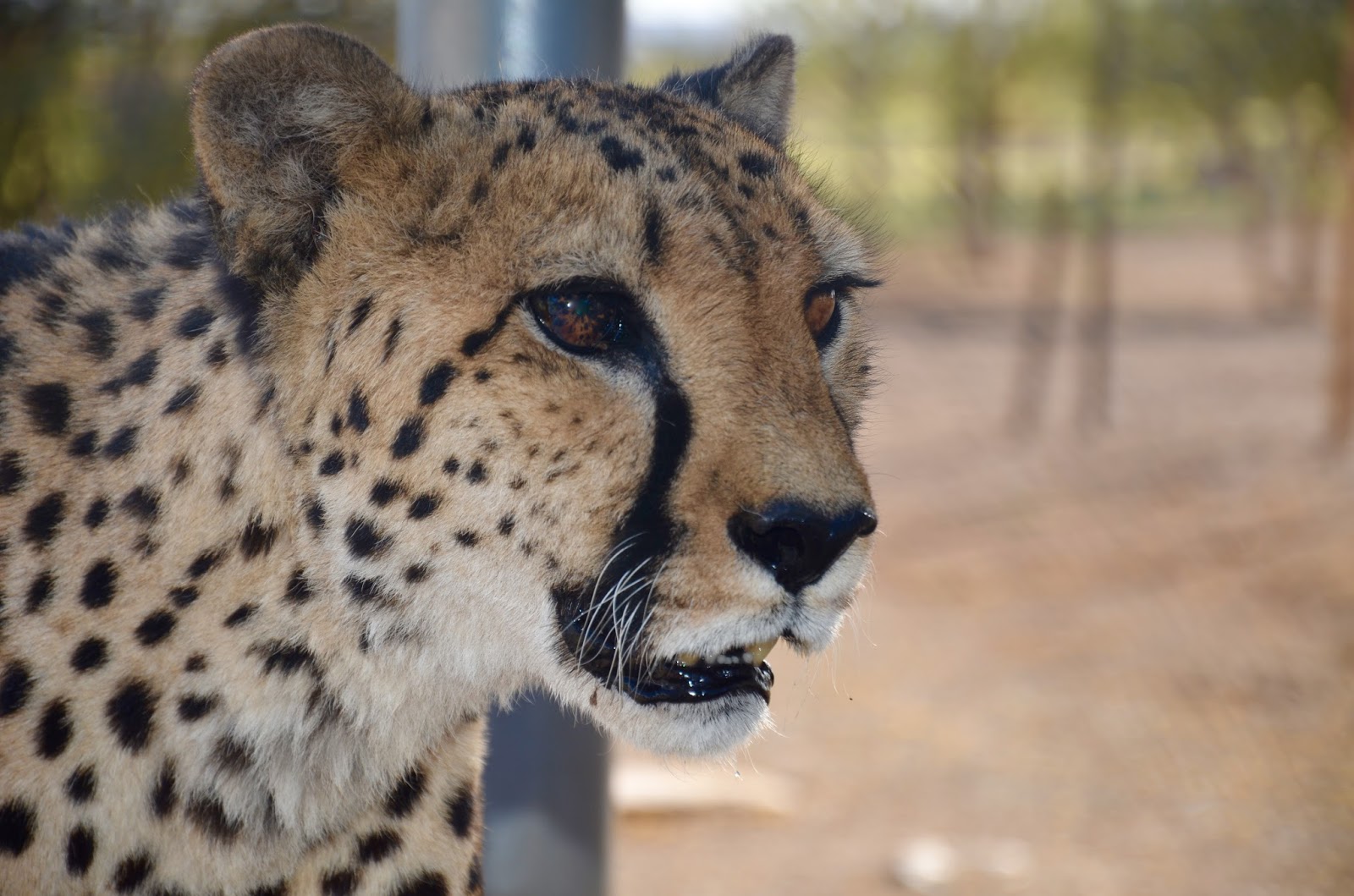
 female cheetah
 rock hyrax posing
lizard sunning himself on the balancing rocks
 thunderstorm moving in, it looked like a nuclear explosion.  We got caught in the rain, it was so heavy that we could not see 1 metre in front of us, the road became a river, it was pretty scary, but thanks to Dan's great driving, we made it.
 the landscape goes on forever, this is southern Namibia
African thunderstorm and rainbow.  Fortunately we were parked when this one it, it was a flash flood in the desert, they only had 9mm of rain this year until this storm hit,  15mm fell.  There were rivers everywhere, a car got stuck in the laneway and had to be towed out.  Most of the water had soaked in within 1 hour.  I have never seen rain come down that hard.

Namibia is a country of changing landscapes, drive for a 15 minutes and it changes, turn a corner and it changes.  It is a beautiful and rugged country.  Many times, we are the only people on the road.  You can see clouds of dust in the distance before you can see the vehicle that is making it.  Often there are oryx, the national animal of Namibia, on the side of the road.
The people are so friendly, they wave from the side of road, adults and kids.
They have young men who guard your car for you when you park it.  They wave you into a spot and watch your vehicle so no one can break into it.  They carry your groceries and will stop traffic so you can back out.  They are not employed by anyone but are official.  It helps stop theft and employs people.  You pay they whatever you think, 50 cents.  We give them $10 Namibian dollars (1 Cdn) and they are over the moon.  Its the same in the gas stations, they pump your gas, clean your windows and check your tire pressure, all for whatever you give them.  They are not employed by the service station, but are sanctioned by them.  The security guard in one of the liquor stores, got cold ciders for me, carried them to the cash and out to the car.

Cheers
Kim and Dan

Monday, February 13, 2017

Luderitz and Kolmanskop

We travelled south then north from Ai-Ais along the South African border, along the Fish River, fortunately it was not flooded.  It was stunning scenery with the mountains and the river, which had water in it.
Luderitz, which was a very important port in the 1800's was bought for 100pounds and 200 rifles.  They then found diamonds lying on top of the sand and the boom began.  At first, they crawled along the sand (commando crawl)  and picked up the diamonds.  Then they had to dig for them.  Between 1908 and 1914, they removed over 5 million carats of diamonds.   Now they "dive for diamonds"  where they suck up the ocean floor and sieve for the diamonds.  They built a town, Kolmaskop in the middle of the desert.  They had grand houses, a bowling alley, butcher, ice making shop, dry goods store, a 220 bed hospital with an Xray machine and a theatre which had acts brought in from Germany.
There was  large dining room, champagne bar for the ladies and smoking room for the men.  There was a school.  It had electricity and a train line was built in 10 months.  There was a seawater swimming pool (the water was pumped from the ocean 35km away).
There were a lot of bachelors working there and they would take pictures of the palm trees in Swakopmund.  They would send them to their girlfriends in Germany enticing them to come.  The ladies would show up in fur coats, having no idea how harsh the climate was.  The men would pay the ships captain to drop them off in the dark, so they could not see how desolate it was.  Most of the ladies went back to Germany.  It was almost abandoned when they found a richer diamond deposit on the Orange River in the 1920's.  The last 3 families finally moved out in 1959.
Now the desert is taking it back, it is really eerie to walk through the buildings that still have fancy woodwork and floors, but are being buried in sand.
Luderitz has to be one of the windiest places on earth.  It is quite cool, had to wear a coat in the evening.  It serves as a port, mostly for fishing and the diamond boats.
Cheers Kim and Dan
 Kolmanskop, one of the houses slowly being buried in sand
 jelly fish, dozens are washed up on the beach every day
 George Haus built by one of the men who made a lot of money in diamonds, he and his wife only lived here for 2 years, the view is stunning
grand staircase in one of the houses, the woodwork was amazing, very detailed.  The wood floors are still there under all the sand

Pictures from our game drive on the Kalahari

Some pictures from our game drive on the Kalahari

 Springbok grazing in the early morning
 Giraffes, all males, looking for the ladies
 oryx, the national animal of Namibia
Blue wildebeest, have very poor eyesight, so they usually hang out with zebras who can spot danger and warn them

Fish River Canyon

Sorry its taken so long for my next post, but a combination of dependable WiFi and my woefully inadequate tech skills have made it difficult.
Right now I am sitting by the pool in the Namib desert, where it is raining all around us but not here, guess that's why its the desert!
We headed from the Kalahari to an overnight stop at the Quiver tree forest and cheetah sanctuary.  It's a really cool spot with a menagerie of orphaned animals that have been given to the owners as they are real animal lovers.  3 cheetahs, which we got to watch being fed and pet, yes, I still have both my hands and all my fingers, 1 adult warthog and 3 babies, 10 dogs, a large lizard, meerkats and lot of birds.  It's run by an Namibian couple who are very helpful and friendly.
Just up the hill from the campsite is the quiver tree forest, it is unusual to have this many trees all in one place.  They are a desert tree, actually a member of the aloe family, and usually grow alone on the side of rocky slopes.  They can survive in very dry climates and drop their "leaves" to preserve water.   They got their name as the San made the quivers for their arrows from the tree.
We then headed to Fish River Canyon which is the second largest canyon in Africa, 1000m deep and up to 20km at its widest.  It is a canyon within in a canyon.  It was formed when with a fracture in the earth's crust, which was deepened by glaciers.  Later more faults and erosion formed the canyon within the canyon.  It is really deep and hot, it can reach 50 deg C in the base.  The Fish River runs through it, it is amazing there is any water as its so dry and hot.  The rocks are made of layers with many colours.
There is a lovely campsite there but you have to watch out for the baboons, they will steal your food if you are not nearby.  One lady had to chase it out of her car with a chair!  We brought a squirt gun but so far, have not had to use it.
We then headed to Ai-Ais hot springs, meaning hot water which is in the southern tip of Namibia, close to the South African border.  The hot springs are 65degC which is not very appealing when it 38deg.  They mix the water with cool water to fill the huge pool, so its about 28deg, which is Dan temperature.  This is where the Fish River Canyon ends.
cheers Kim and Dan
Cheetah having her dinner

 Ground squirrel checking out the scenery
 Quiver tree forest at sunset, stunning

Fish River Canyon

Saturday, February 4, 2017

Kalahari Desert

After what seemed like days traveling, we finally made it to Namibia.  KLM business class was excellent, one of the best flights we have had for service.  The captain even stopped to chat with us and when he found out about our travel plans, he sent us a special message from the flight deck.
We are definitely not roughing it, our camper has a big bed, fridge, microwave and A/C (which is a must as it was 35 deg in the desert today).
We are staying over in the Kalahari Desert tonight.  The Kalahari is not a true desert, it receives too much rainfall to be a "real" desert.  Right now it is green and lush, with a magnificent contrast between the red sand and the green vegetation.  It is so green now as it is the rainy season, which means its sunny in the morning and tends to cloud over in the afternoon with a spectacular thunderstorm, then tends to clear overnight.  It is so fresh after the rain, although a bit humid.  There is a gentle breeze blowing now as the sun sets over the desert.  We are enjoying it with some great and inexpensive (read cheap) South African wine.  Alcohol is cheap here, we bought 24 beer (large cans), 12 bottles of cider and 6 bottles of wine for $100 Canadian.  Petrol (gas) is about the same price as at home, I think I prefer the cheaper alcohol!
The Africans' have some great names for their business, they are quite literal.  We saw a psychologist whose business was called "Let's Talk",  the Dove Life Insurance next to the Dove funeral home.
I am going to try to get pictures of all the interesting business names.
So far we have seen impala, meerkats,  and baboons just driving along the main highway. The landscape has gone from hilly to flat, green to brown then green and red.  It looks a lot like parts of Australia, which is not surprising as they were once joined.
We dine under the stars tonight in the desert and then a game drive tomorrow.
impala grazing on the lush grass in the Kalahari, in a few months, it will be brown

rolling red dunes of the Kalahari
our camper, most campsites in Namibia have shades or trees for shade

Happy Travels
Kim and Dan